
A bust of Chakravarti Rajagopalachari, the first Indian governor-general, has replaced a statue of British architect Edwin Lutyens at Rashtrapati Bhavan, symbolizing a move away from colonial influences and embracing Indian heritage.

Two of the three strikes are related to the gig economy, a centrepiece of the new labour Codes.

Benchmark lending rates unchanged with repo rate at 5.25%

One of the most uncivilised characteristics of this war has been the total disregard for international law and the laws of armed conflict, asserts Vice Admiral Biswajit Dasgupta (retd).

Next week's three-nation foreign tour of Prime Minister Narendra Modi will see India and Oman sign a free trade deal. The visit will also pave the way for agreements with Ethiopia and Jordan to increase India's bilateral trade and investments.

'The West Asia or the Gulf crisis has shown that what we develop as national infrastructure when things are not as bad as they could be, we forget to plan for adversities.'

'A genuine tribute to Dr Ambedkar does not lie in selective invocation. It lies in asking a harder question: Is the Constitution still doing its job -- restraining even assertive majorities?' asks Manoj Mohanka.

Tarique Rahman, after 17 years in self-exile, has led the Bangladesh Nationalist Party (BNP) to a significant victory, becoming the country's Prime Minister. This marks a major turnaround for the BNP after years of being targeted by the Awami League government.

The Congress party has strongly criticized the Union Budget, calling it 'lacklustre' and 'disappointing,' claiming it fails to address the needs of farmers, unemployed youth, and other key sectors.

India's gross GST collection increased by 8.1 per cent to over Rs 1.83 lakh crore in February, driven by higher import revenues and improved domestic sales. Despite some states reporting negative or below-average growth, experts see the overall trend as a sign of a maturing tax ecosystem and a confident domestic market.

The government has intensified its Study in India programme and is working closely with universities and states to achieve this goal.

Sensitive issues remain. Water sharing of the Ganga and Teesta rivers. Treatment of minorities, particularly Hindus. Border management. Trade imbalances. Connectivity projects.What happens next will shape not just bilateral ties, but the balance of South Asia itself, points out Ramesh Menon.

Benchmark stock indices Sensex and Nifty closed higher on Thursday, helped by a rally in blue-chip Larsen & Toubro and the Economic Survey projecting the GDP growth of 6.8-7.2 per cent for the next fiscal.

'The BJP is keeping its options open and that the final decision is still tightly held.' 'That is consistent with the party's tendency to preserve suspense, avoid premature factional conflict, and use leadership selection as a way of resetting internal hierarchies.'
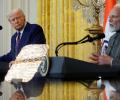
India and the US have entered a new phase in their relationship, marked by greater parity, point out Harsh V Pant and Vivek Mishra.

India's retail inflation, which has stayed below the Reserve Bank of India's (RBI's) 4 per cent target in recent times, is likely to remain benign in the coming months, RBI Deputy Governor Poonam Gupta said in a speech, on Friday, which was uploaded on the central bank's website on Tuesday. Headline inflation dipped to multi-year lows of around 1.5-2.8 per cent in late 2025.

A new survey indicates that Indian employers are planning to increase hiring in the April-June quarter, driven by strong business confidence and domestic demand. The survey also highlights the impact of AI adoption on workforce strategy and the challenges of talent scarcity.

'The unregulated marketing has to stop. People are getting recommendations for this from gym trainers, from marriage counsellors -- that is simply unacceptable.' ''There are many ways to lose weight -- eat less, fast, exercise, eat healthy. That is how you lose weight.'

The deal shifts the US posture towards India from hostile to neutral, and that matters for growth, points out T T Ram Mohan.

The Supreme Court's ruling in the BPSL case exposes deep flaws in the IBC's institutional framework and raises concern about judicial overreach, notes Rajeswari Sengupta.
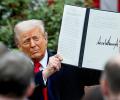
India needs another shot of difficult reform, of the kind only possible at gunpoint. Mr Trump holds that gun to our heads now. A drastic reduction in tariff protection, other elements of sarkari wet-nursing will force entrepreneurial India to become competitive again, argues Shekhar Gupta.

'We want reforms to end poverty, illiteracy and improve the health conditions of millions of people. We want reforms to ensure that there are jobs for the millions of unemployed youth,' says CPI General Secretary A B Bardhan.

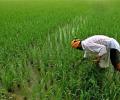
India is already a heavyweight in global farm trade in pockets such as rice exports, but experts are urging a pivot from a subsidy- and procurement-driven mindset to a productivity and nutrition strategy that still shields farmers from volatility.

British billionaire Jim Ratcliffe apologises after claiming the UK had been 'colonised by immigrants,' sparking criticism from political leaders.

The Trinamool Congress (TMC) has released its manifesto for the West Bengal elections, focusing on welfare politics and women's empowerment with pledges to expand existing schemes, improve healthcare, and develop infrastructure.

Victory wrested from regime that only listens when forced, the TMC said on GST exemption on insurance.
Finance Minister Pranab Mukherjee also asserted there's been no pressure by the United States for India to enact financial sector reforms, particularly in the banking and insurance sectors, on the eve of President Obama's visit.

The "huge mountain of debt" in developed economies and the risk of a possible unravelling is a matter of concern for India, Union Minister for Railways, Information & Broadcasting, Electronics & Information Technology Ashwini Vaishnaw said on Wednesday, pointing to the recent spike in Japanese bond yields.
India will probably unveil bold reforms in its budget on Thursday in a bid to turn around an economy growing at decade lows.

India's economy experienced a growth of 7.8 per cent during the October-December quarter of 2025-26, according to the new series of national accounts with 2022-23 as the base year.

Prime Minister Narendra Modi launched a strong attack on the Congress party, accusing them of being unable to accept their repeated electoral defeats and highlighting the achievements of his government.

Governments should move away from universal subsidies towards tightly targeted transfers, backed by stricter eligibility norms, sunset clauses and periodic audits to curb leakages and improve spending efficiency, a joint study by Asian Development Bank and PwC has recommended.
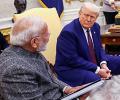
To those who ask, "Is all this really worth it? Why can't domestic demand fill the gap?", it is important to remind them that only 13 economies since the Second World War have grown at 7 per cent or more for 25 years -- like India needs to. They all had one thing in common: Strong export growth underpinned by strong global engagement, explains Sajjid Z Chinoy.

'Among corporates, about 60% of income is now reported under the new tax regime.'
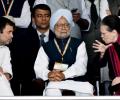
He drew the roadmap of India's economic reform, unshackled it from the licence raj and pulled it back from the brink when even its gold reserve was pledged.

Reiterating Sitharaman's statement that this is a youth power budget, Modi emphasised that the provisions made in the budget will prepare leaders, innovators and creators across different sectors.

The key question is how much of the latest growth record represents recovery from the 2020-2021 downturn, and what is the sustainable growth rate now, asks T N Ninan.

India is growing fast, but to keep growing strong, the government must make more things at home, create jobs, and spend money wisely, suggests Rajiv Memani, regional managing partner, Africa-India Region, EY.

While many areas compete for resources, defence, education, and adaptation deserve focus for maximum impact, suggests Laveesh Bhandari.
